

Piitaapan mural
Published: August 20, 2025
By Ryan “Amik” Besito (Anishinaabe)
The story this mural carries
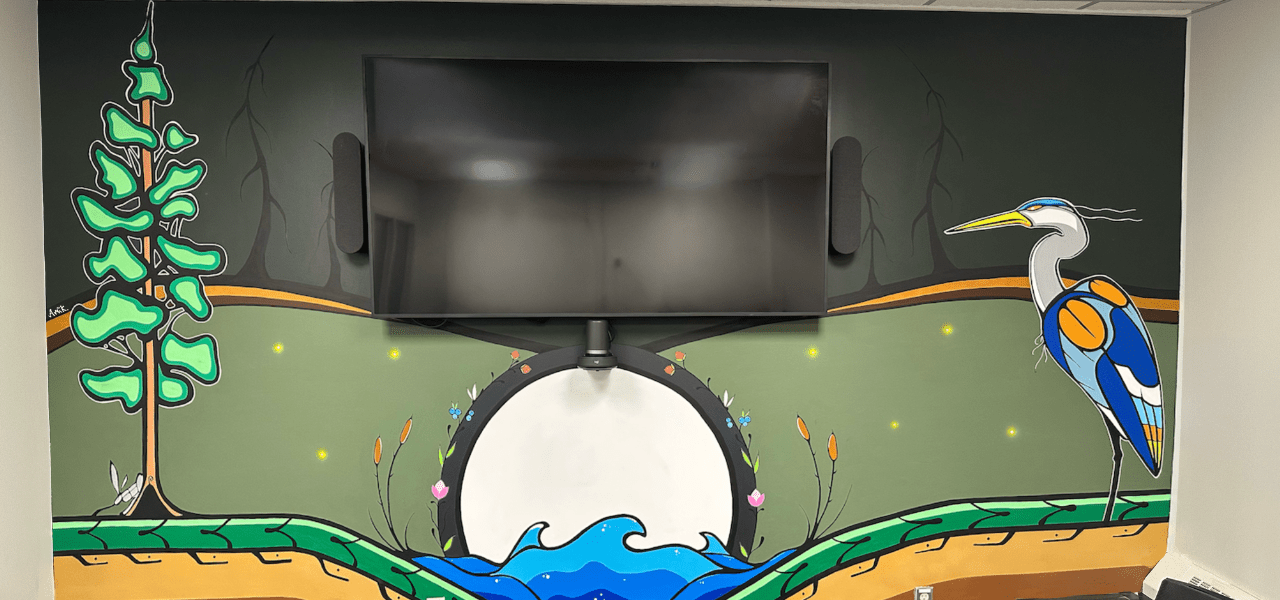
This mural is a visual teaching told through the lens of two-eyed seeing, an approach that honours both Indigenous and Western ways of knowing and guided by the Anishinaabe concept of Piitaapan, meaning “the moment before the first light touches the Earth.” It is in this liminal space, where teachings dwell and possibilities begin.
Here, each element holds meaning. Each carries memory and motion and together tells a story of balance, rebirth and relationships.
The White Pine: The Tree of Peace
On the left stands the White Pine, known as the Tree of Peace. Its five needles bound together represent unity among nations, as taught in Haudenosaunee teachings. For Anishinaabe, it reminds us of our connection to the land and our responsibility to future generations. Deep roots. Steady growth. Shelter and medicine.
Beneath it, you may see the presence of Naanaboozho, the rabbit, our first teacher and a trickster figure in Anishinaabe storytelling. He reminds us to remain curious, humble and open to learning.
The four Ancestor Trees: Shadows of the beforetime
In the background, standing quietly and subtly, are four Ancestor Trees. They are rendered in shadow, neither fully here nor gone, representing the lineage of those who walked before us.
They are the grandparents whose names we may not know, the ones who endured, resisted and remembered. Each tree holds memory: of stories passed down, songs once sung and lessons learned over lifetimes. They remind us that we are never alone in our learning and that we walk a path shaped by roots that run deep.
Their presence affirms the importance of ancestral guidance, and the ways their strength lives within us, even if we can’t always see it clearly.
Water and land: The breath between worlds
At the centre flows water, sacred and life-giving. The waves rise toward a circular portal, a moment of sunrise, a symbol of Piitaapan, the spiritual threshold where clarity can come.
The land beneath is alive. Interwoven green represents sweetgrass, one of our four sacred medicines. It teaches kindness, purification and the strength found in braiding together mind, body and spirit.
Fireflies: The light of the ancestors
Scattered gently throughout the mural are fireflies, tiny illuminations in the dark. They are the memories, thoughts or spirits of our ancestors, showing up when we need guidance. In classrooms, they represent knowledge lighting the way.
Blue Heron: The watcher
To the right stands the Blue Heron, a being of grace and stillness. In many Indigenous teachings, the heron is a watcher, a solitary traveler who teaches self-determination and reflection. Here, it watches the water, knowing that truth takes patience, and the land teaches us if we are willing to sit long enough.
Two-Eyed Seeing / Etuaptmumk
This mural is created through Two-Eyed Seeing: a guiding principle gifted by Mi’kmaw Elder Albert Marshall. It asks us to view the world through one eye with the strengths of Indigenous ways of knowing, and the other with the strengths of Western knowledge and to weave both together for a more whole understanding.
By embracing Two-Eyed Seeing:
- Science and story can coexist.
- Research and relationship can support one another.
- Classrooms can become places of both intellect and spirit.
Two-Eyed Seeing reminds us that education doesn’t just live in books, it lives in the land, in the body, in ceremony and in community. For Indigenous students and faculty, this framework creates space for their teachings and worldviews to not only be included, but respected and centered.
This mural, therefore, is more than an artwork, it is a visual commitment to this framework. It invites students, staff and visitors to learn through both eyes, both worlds, and to recognize that a fuller understanding emerges when we honour them together.
Closing words
This mural is not a static image, it is a teaching lodge in paint, a moment of sunrise held in stillness. It reminds us that the land is not something we learn about, it is something we learn from.
May you pause. May you listen. May you carry something forward.